For a board where technology decides whether the plan works.
Increasingly that means forming a view on adopting AI without anyone in the room having done it before. Three problems, three companies, three sales since 1999, and I have sat on both sides of the board table: as the chief executive reporting to one, and as a director on two.
I am looking for one seat, so that it gets proper attention.
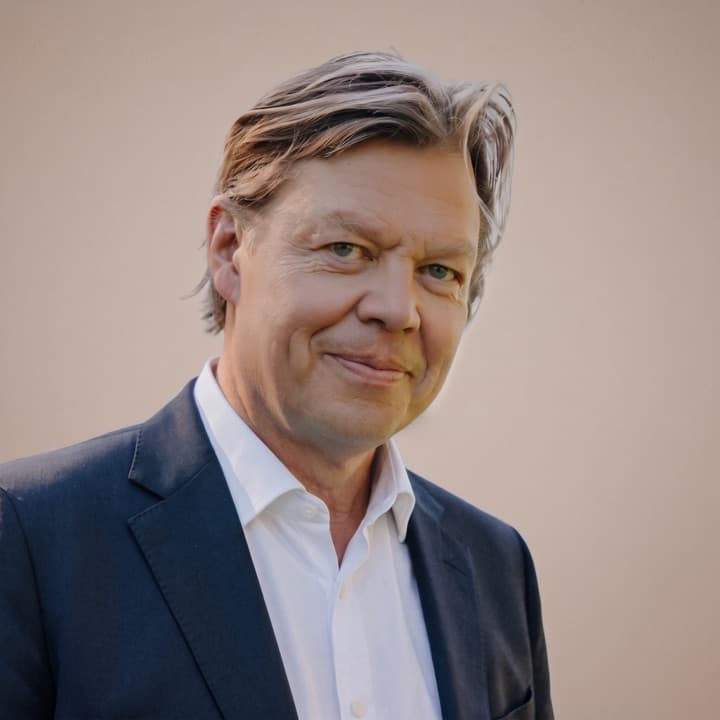 Frank Mogensen
Copenhagen
Most technology problems turn out to be business problems.
In each of the three companies, the thing that was broken was not the engineering. It was a commercial or operating model that everyone had stopped questioning, and technology was what made a different one possible.
That is the habit I bring to a board: working out which problem a company actually has, before agreeing what to spend on it.
Alpha IT Group
In 1999 companies were paying more each year for IT while consultants configured infrastructure by hand, and nobody could say what the next year would cost. We built an automated hosting platform and sold something nobody was selling yet: infrastructure and operations at a fixed rate per employee per month.
Unpredictable project cost → a fixed price per head, a decade before that was normalSold to Mondo A/S in 2007 for DKK 30 million. Computerworld, June 2007Voopii
Mobile data roaming was priced so badly that most companies simply switched it off when their people travelled. They had bought a capability and then told staff not to use it. We assembled a global roaming service across multiple operators so companies could work at local rates anywhere in the world, and sold it to enterprises and airlines.
A capability switched off because of price → local rates worldwideCloudeon
Consulting for large enterprises, I kept meeting the same thing: three to five years from an idea that would help a customer to something actually in production. By the time it arrived the idea was outdated, and the person who had it had usually left.
That is not a delivery backlog. It is an operating model with a cycle longer than the shelf life of its own ideas. Fixing it took cloud as the foundation and a different way of working on top, which we built and then ran for large enterprises.
I was chief executive from the start. About a year before the sale I handed that over and became CTO, to build our Lithuanian organisation myself: fifty people across Vilnius and Kaunas doing 24×7 operations, service development and SaaS innovation.
Three to five years to production → days or weeksTDC took a 40% stake two years in. DLA Piper, August 2018 · Sold to Devoteam in 2021 at ~100 people. Computerworld, September 2021The same move three times. Manual configuration at unpredictable cost became a fixed price per head. Roaming so expensive it was switched off became local rates worldwide. Three to five years to production became days or weeks. The innovation was the commercial model each time; the technology existed to make it possible.
Challenge, and knowing where it stops
I question things that have stopped being questioned, which is a director’s job and not management’s. The change belongs to the executive team; my part is being sure they can make it, and saying so when I doubt it.
What a board needs from management
I have run three companies with a board and a chairman above me. I know what to ask for, because I was the one being asked, and what it looks like when a report is comfortable rather than true.
Adopting AI, as a business decision
Three years on it, a chairmanship of an AI company and investments in two more. At board level what matters is what it can be trusted with, what stays under human decision, and who answers when it is wrong.
Risk, and technology risk with a number on it
Setting what the company will accept and holding it there, including cyber and delivery risk, where boards most often accept a figure they cannot interrogate.
Transactions, capital and succession
Three sales answered from the seller’s side, corporate investment raised from TDC, and a chief executive handover I made myself. Most directors have only read about that last one.
Duties and reporting
Danish company-law duties, board liability, financial oversight and sustainability reporting, examined at CBS rather than assumed. Finance, cyber, people and operations come from running the companies, not from a course.
As founder and chief executive of three companies, each with its own board and chairman. This is the part most technology candidates do not have.
Board member and investor at Workofo, AI workforce scheduling. Chairman and investor at Agency AI Solutions, 2025–26. Both mandates ended when I stepped back for personal reasons. That period is behind me, which is why I am taking one seat rather than several.
CBS Executive board exam, a six-month examined programme, 2023–24. Information Technology, Technical University of Denmark.
I helped start Nordio AI; it has its own chief executive and I am not in day-to-day operations. No competing board commitments, and able to commit for a full term. Past investments in companies I have served are disclosed before a committee meets, not after.
Banking, insurance, medical, retail and large organisations, as customers and as an operator. The size of the company matters less to me than whether the problem is the interesting one.
The change is management’s to make. The board’s job is to be sure they can.
I have spent twenty-six years being the person who had to deliver it, which is why I know when a plan is sound and when it is optimism with a timeline attached. That is what the seat is worth: oversight, not a second pair of hands on the wheel.
If you are putting a board together, or filling a seat, write a few lines about what it concerns. You do not need to have finished thinking.
Email frank@fmogensen.dk
Telephone +45 21 33 11 33
Book a call calendly.com/frank-fmogensen
LinkedIn linkedin.com/in/frankmogensen